



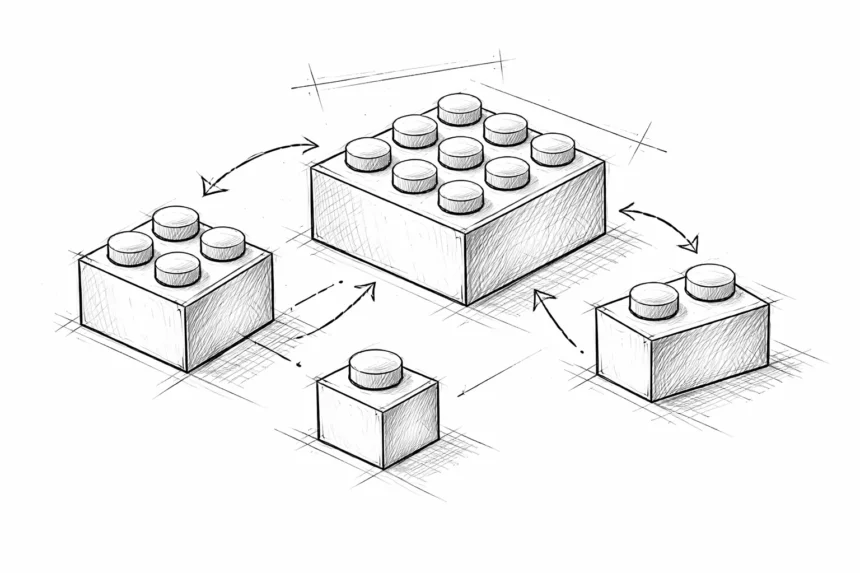
Innovation programs fail for predictable reasons: unclear mandates, random projects, underpowered teams, performative metrics, and a pipeline that never reaches launch. The fix is not more brainstorms or a bigger tool stack. It is a set of durable building blocks that turn ideas into proof-of-concept, then into pilots, then into revenue, savings, or mission impact.
The strongest programs treat innovation like a product line with governance, portfolio logic, and a repeatable operating system. They invest early in human-centered design, rapid prototyping, and interoperability, then build the go-to-market muscles that most internal labs lack. If you want consistent outcomes, focus on the eight components below, in order. Each one is practical, testable, and designed to scale without burning out your best people.
1. A clear mandate with decision rights
Start with a crisp definition of why the program exists and what it is allowed to change. Is the mandate growth, cost reduction, risk reduction, sustainability, or a mix? Please write it down, then assign decision rights: who can greenlight discovery work, who can fund pilots, who can approve production launches. Strong programs avoid “innovation theater” by tying decisions to a small steering group with absolute authority and a predictable cadence. If your stakeholders cannot answer “what gets fast-tracked and why,” you do not yet have a mandate.
2. A portfolio thesis, not a project grab bag
High-performing teams manage a portfolio across horizons, risk levels, and time-to-value. Create categories like core optimization, adjacent expansion, and breakthrough bets, then set target allocation ranges for each. Add explicit kill criteria so teams can exit weak ideas quickly without politics. A portfolio thesis also defines where you will not play, which protects focus and credibility. If every request becomes “a priority,” you will end up with half-built prototypes and no product-market fit.
3. A funding model that matches learning speed
Innovation needs money in tranches, not all-or-nothing budgets. Use stage-gated funding tied to learning milestones: problem validation, proof of concept, pilot readiness, scale decision. Keep early-stage budgets small and fast so teams can run experiments weekly—Reserve larger dollars for pilots with committed operators, data access, and a clear path to adoption. The goal is to buy learning cheaply, then invest aggressively when evidence is strong. If finance only understands capex projects, teach them the economics of options.
4. A repeatable discovery-to-delivery operating system
A program is only as strong as its weekly habits. Standardize how ideas enter, how teams run discovery, and how they ship pilots. A lightweight playbook should include human-centered design research, rapid prototyping standards, security and privacy checkpoints, and a handoff path to product or engineering. Keep templates short and enforce them through coaching, not bureaucracy. Repeatability is what lets you scale across teams while protecting quality. If every squad invents its own process, outcomes will vary wildly.
5. The right team shape, incentives, and time allocation
Innovation cannot be a side quest for people with full-time jobs. Define roles and protect time: product lead, designer, engineering, data, domain expert, and a business owner accountable for adoption. Add a bench of specialists for accessibility, sustainability, and regulatory review so teams do not reinvent compliance each cycle. Align incentives to shipped impact, not activity. Promotions should reward learning velocity, cross-functional leadership, and measurable outcomes. If the best people avoid the program, your incentives or sponsorship are broken.
6. Infrastructure that enables speed and interoperability
Tooling matters, but only when it removes friction. Provide shared environments for prototyping, data sandboxes, API gateways, and modular components that teams can reuse. Bake in security, privacy, and observability, so pilots do not stall at the first review. Favor open-source where it reduces lock-in and improves auditability, but standardize how it is approved and maintained. Interoperability is the multiplier: the easier it is to integrate with core systems, the more likely pilots become production. If your prototypes die at integration, fix the plumbing.
7. An ecosystem strategy for partners, universities, and startups
Strong programs do not innovate alone. Build a partner map by capability gaps: labs-to-market research, specialized hardware, niche AI tooling, manufacturing, and distribution. Establish lightweight contracting paths for pilots so you can test quickly without months of procurement. Use accelerators, universities, and standards bodies to stay current and to recruit talent. Create clear rules for IP, data, and security up front so collaborations do not collapse under legal uncertainty. If partnering feels more complex than building, your operating model is too rigid.
8. Metrics that track learning, adoption, and business value
Count outcomes, not optimism. Early stages should measure learning velocity: experiments run, time to insight, validated assumptions, and customer pull. Later stages should measure adoption: active users, retention, workflow penetration,n and operational readiness. Tie mature initiatives to value, such as revenue, margin, cycle time, defect rate, or risk reduction, with owners accountable after launch. Maintain a single portfolio dashboard that leaders trust. If you only report the number of ideas, you are measuring motion, not progress.
Closing
Innovation programs win by being boring in the right ways: transparent governance, disciplined portfolio choices, and a repeatable path from insight to scale. Build these eighblocks, and your team can move fast without creating chaos. The payoff is not just more ideas. It is a reliable engine for proof-of-concept, pilots, and products that actually land.