


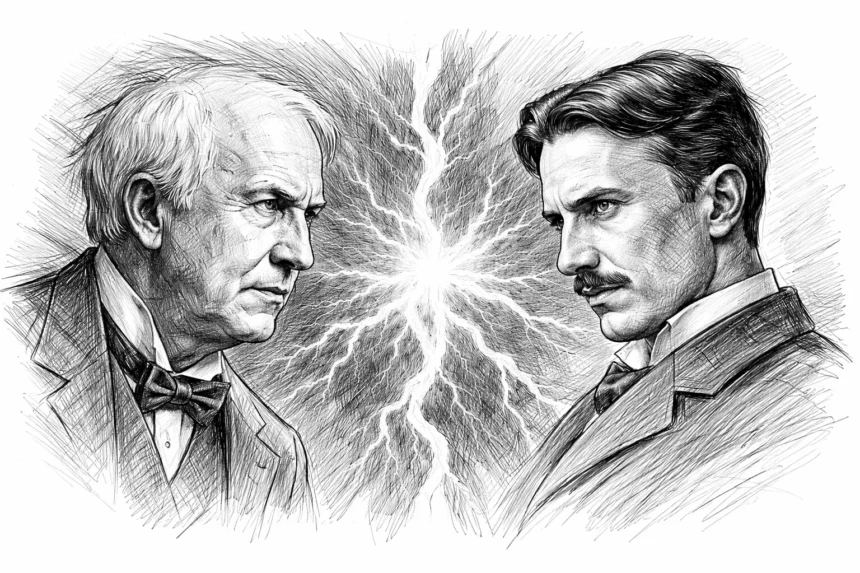
Nikola Tesla stepped into New York in 1884 with almost nothing in his pocket and a head full of electrical ideas that did not fit neatly into the business Thomas Edison was building. Edison had already proven he could turn inventions into systems, not just gadgets. Tesla arrived obsessed with a different kind of system, one that could send power far beyond a few crowded city blocks.
Their “rivalry” is often told like a boxing match between two lone geniuses. The real story is more interesting. It is a collision between engineering philosophies, business incentives, and timing. It is also a reminder that once an invention becomes infrastructure, the fight is rarely about elegance. It is about what can scale, what can be financed, and what the public will accept as safe.
Key Takeaways
- Tesla worked for Edison’s organization briefly after arriving in the United States in 1884, and their working relationship ended quickly amid conflicting accounts about pay and expectations.
- Edison’s early power business was built around low-voltage direct current (DC), which worked well in tight geographic areas but struggled as cities and customers spread out.
- Tesla’s most consequential contribution to the rivalry was not a light bulb but a practical alternating current (AC) motor and the broader polyphase AC system that made large-scale power transmission far more workable.
- The “War of the Currents” became a public battle over safety, including grim demonstrations and the electric chair, not just an engineering debate.
- By the mid-1890s, obvious projects such as the 1893 Chicago World’s Fair and the power transmission from Niagara Falls to Buffalo helped cement AC as the dominant standard for electrical grids.
The Person Behind the Invention
Thomas Edison and Nikola Tesla were not working on the same problem from the same starting line.
Edison was already a system builder by the time Tesla arrived. He had the practical shop culture, the investor network, and the habit of building an entire ecosystem around an invention. By the early 1880s, Edison’s work was not only about making a lamp glow. It was about creating a customer trust in an electrical service enough to replace gaslight. That meant generators, wiring, meters, switches, and a business model that could survive city politics and maintenance headaches.
Tesla came from a different tradition. Sources describe him as deeply theoretical compared with the industrial labs around Edison. He was the kind of engineer who wanted the math and the field behavior to click into place in his mind, then turn that vision into hardware. He had already been thinking about alternating current and rotating magnetic fields before he came to the United States, and he believed an AC motor was the missing piece that would make AC power systems truly complete.
When Tesla reached New York, he carried an introduction that, according to later retellings, praised him highly to Edison. Whether every detail of that meeting is perfectly preserved is hard to prove, but the broad outline is consistent across major accounts: Tesla got a chance inside Edison’s world, and it did not last long.
Their personalities did not help. Edison’s reputation was built on relentless iteration and practical results. Tesla’s reputation was built on visionary leaps and a willingness to pursue ideas that looked impractical to managers trying to ship hardware next week. Those styles can complement each other in a healthy lab. They can also collide fast when money and credit are on the line.
The Problem They Set Out to Solve
The rivalry only makes sense when you treat electricity as a product, not as a science experiment.
Edison’s central challenge was to make electric lighting reliable and acceptable to ordinary customers. Direct current is fit for that early mission. DC systems could be engineered in a controlled way, and Edison pushed a low-voltage approach that felt safer and more predictable to sell. The catch was baked into the physics and the infrastructure: low-voltage DC did not travel well over distance. Voltage drop, copper costs, and the need to keep customers close to generators turned the city into a patchwork problem.
Edison’s Pearl Street station in Manhattan is a good example of what he was building: a concentrated, urban power service that proved the concept of central generating stations. It was a milestone, but it also revealed the scaling problem. If you needed a generating station in every small area, growth meant more stations, more capital, more complexity, and an increasingly awkward map of where power could reach.
Tesla’s problem was different. He was not trying to win customers block by block. He was trying to integrate power distribution and motors into a unified system over long distances. Alternating current, paired with transformers, could be stepped up to high voltages for transmission and stepped down for safer use at the end. That made the distance problem far more manageable, at the price of a new safety debate and new engineering demands.
The fight, then, was not “DC is bad, AC is good.” The fight was about which system could become infrastructure first, under real-world constraints, and which company could convince cities and regulators that its system was safe enough to put above streets and inside buildings.
The Long Road to Breakthrough
Tesla’s short time connected to Edison is the dramatic spark, but the long road is what mattered.
A brief overlap in 1884, and a messy breakup
Tesla worked within Edison’s orbit after arriving in 1884. Multiple accounts agree it was brief. Where the record gets fuzzy is why it ended. Tesla later described disputes over promised compensation. Other historians point out that the famous “bonus” story has inconsistencies, including the sheer size of the number sometimes claimed, and the fact that the period’s documentation does not cleanly settle the question.
That uncertainty is worth sitting with, because it is a classic inventor trap. When you are early, broke, and desperate to prove yourself, you can hear promises as contracts. When the other side is juggling payroll, deadlines, and a chaotic shop floor, they can treat promises as motivational talk. If the agreement is not written clearly, the ending is rarely dignified.
Tesla left, and whatever personal feelings remained were left behind as the competition moved to a much larger arena.
Tesla’s AC motor becomes the missing key.
AC lighting and transmission could work without Tesla, but Tesla’s motor patents helped make AC feel like a complete platform rather than a partial trick. In 1888, Tesla filed key patents related to the induction motor, and in the same year, George Westinghouse acquired rights to Tesla’s AC motor patents. That deal matters because it attached Tesla’s technical work to a company that could manufacture, deploy, and litigate.
A power system is not just generation and wires. It is what you can do with the power at the other end. Motors meant industry, transit, and practical applications beyond lighting. When AC could plausibly run factories and equipment, it started to look inevitable.
The War of the Currents turns into a public fear campaign
As AC systems spread, the battle became political and emotional. Safety was not a side issue. People were genuinely being injured or killed by electrical infrastructure in the late 1880s, and cities were understandably alarmed. The question was how that fear would be shaped.
Edison’s side argued that high-voltage AC was uniquely dangerous. Public demonstrations escalated the argument into a spectacle. Some sources describe behind-the-scenes cooperation between Edison’s interests and figures who staged or promoted electrocution demonstrations to associate AC with death.
The electric chair became the darkest symbol of that campaign. The first execution by electric chair took place in 1890, using alternating current. The details are grim, and the outcome was not the clean, instantaneous death some promoters claimed it would be. Even if you strip away mythmaking, the chair’s origin story shows how quickly a technology debate can get pulled into public morality plays.
This period is also a reminder that “winning” does not always look like a neat technical proof. Sometimes it seems like controlling the narrative long enough to slow a competitor, influence regulation, or protect patents while your company catches up.
The 1893 Chicago World’s Fair becomes a live demonstration at the city scale
If the electric chair symbolized fear, the 1893 World’s Columbian Exposition in Chicago symbolized wonder.
Westinghouse won the contract to illuminate the fair, and Tesla’s polyphase AC system was prominently associated with what visitors experienced as a city of light. Contemporary retellings emphasize the scale: vast numbers of lamps, bright public spaces, and an experience that framed AC as modern, robust, and workable.
A fair is marketing, but it is also proof of logistics. You do not light a giant public exhibition with a fragile system. The fair let ordinary people see electrical infrastructure as something they could trust, not just fear. That mattered as much as any engineering paper.
Niagara Falls and the moment AC looks inevitable
Niagara Falls was the type of project that DC struggled to claim—hydroelectric generation paired naturally with long-distance transmission. The project’s milestones are sometimes summarized differently across sources. Still, a key fact is widely repeated: by 1896, power generated at Niagara was transmitted to Buffalo, New York, a distance that made a strong case for AC’s practicality.
Once you can transmit power from a significant natural source to a distant city, the conversation changes. Electricity stops being a neighborhood service and becomes a regional resource. At that point, the standard tends to follow scale.
By the mid-1890s, the “war” was no longer a fair fight. AC systems were expanding rapidly. Businesses reorganized. Edison’s direct control over his electric companies weakened over time as mergers and financial forces created new corporate structures. The rivalry that began as a clash of individuals had matured into a contest between industrial empires.
Impact and Legacy
The outcome most people remember is simple: AC won. But the legacy is more layered.
Edison’s DC systems were not foolish. They were an early answer to a real commercialization problem. They helped prove that electricity could be delivered as a service with predictable results. That is an invention in its own right, even if it is less romantic than a lone genius sketching a motor.
Tesla’s AC work, particularly in motors and polyphase systems, helped make large-scale electrification practical. It is hard to overstate how important it was to have a system that could transmit efficiently, then serve both lighting and motive power.
The War of the Currents also left a cultural scar. It showed how technology can be framed as dangerous or safe depending on who is telling the story. It showed how standards are shaped by public perception, legal strategy, and the ability to finance massive deployments.
And it left a technical aftertaste that still feels current today. Our grids are still predominantly AC, but modern electronics, batteries, LEDs, solar panels, and many devices run on DC internally. Modern power electronics can convert between them far more efficiently than engineers of the 1880s could imagine. Strangely, the rivalry did not end so much as it evolved into a hybrid world where both currents matter.
What We Can Learn
The Edison-Tesla rivalry is a valuable case study because it is not a clean morality tale. It is a mirror held up to the process of invention becoming reality.
First, a breakthrough is not the same as a platform. Edison’s real advantage was not a single device. It was the system around it. Pearl Street was not only a technical achievement but also a business and logistics achievement. If you are building something that must live in the real world, the “invention” includes supply chains, maintenance, installation, and customer trust. Tesla’s ideas needed a Westinghouse to become infrastructure. That does not diminish Tesla. It clarifies the game being played.
Second, incentives shape what engineers defend. Edison had patents, investments, and a business model tied to DC. It would have been irrational, from his perspective, to surrender that ground quickly. Tesla, meanwhile, had a technical worldview that made him impatient with compromises that slowed long-distance transmission. Neither stance was purely about ego. Each stance was attached to what they had already built and what they stood to lose.
Third, the story is a warning about ambiguous agreements. Tesla’s split with Edison is remembered partly because it feels personal and unfair, but the more profound lesson is procedural. When a young inventor enters a powerful shop, expectations must be nailed down. If you are promised a reward for performance, define the performance and define the reward in writing. It is not romantic advice. It is survival advice.
Fourth, the public narrative can become part of the engineering problem. AC adoption was influenced by fear, spectacle, and regulation, not only by efficiency and transformers. If your invention touches safety, infrastructure, or public spaces, you are not only building hardware. You are creating a story that regulators, customers, and newspapers will retell. Ignoring that story does not make it go away.
Finally, timing and scale often determine what counts as “truth” in technology. DC was workable at a small scale. AC was transformative at a large scale. The winning idea was the one that matched the next expansion phase of the world. If you are inventing today, it is worth asking: what scale of world is coming next, and does your solution grow with it?
The Bottom Line
Thomas Edison and Nikola Tesla are remembered as rivals because their names became shorthand for two competing visions of electrification. Edison built practical systems that proved electricity could be sold and trusted. Tesla helped supply the technical foundation that made electricity scalable across long distances, especially once Westinghouse put manufacturing and capital behind it.
The enduring value of their story is not picking a hero. It is seeing invention as a full-contact sport where physics, money, standards, and public emotion collide. If you can learn to design for all of it, not just the elegant core idea, you give your work a real shot at becoming the thing the world actually uses.
How we wrote this article
We built this piece by cross-checking core dates, projects, and claims across several types of sources: reference works for broad biographical anchors, museum and archival material for concrete historical records, and institutional explainers for the technical differences between AC and DC. Where accounts conflict, especially around Tesla’s compensation dispute during his brief employment connected to Edison, we treated the details cautiously and described the uncertainty rather than pretending the record is perfectly settled. We then shaped the narrative around the invention reality modern builders face: inventions become history when they become infrastructure.
References
- Encyclopaedia Britannica. “Nikola Tesla | Biography, Facts, & Inventions.” Encyclopedia entry. Updated 2025. Used for biographical anchors and Tesla’s arrival in the U.S.
- Smithsonian Magazine. “Edison vs. Westinghouse: A Shocking Rivalry.” Magazine article. 2011. Used for the public safety campaign, Harold P. Brown, and the electric chair context.
- U.S. Department of Energy, Energy.gov. “The War of the Currents: AC vs. DC Power.” Government blog article. 2014. Used for a clear explanation of AC vs. DC conversion and the broad arc of the conflict.
- History (A&E Television Networks). “How Edison, Tesla, and Westinghouse Battled to Electrify America.” History article. Updated 2025. Used for a consolidated timeline of the War of the Currents, including the 1893 fair and Niagara-to-Buffalo milestone.
- PBS. “Tesla: Master of Lightning, Coming to America.” Educational documentary companion page. Year unknown. Used for the widely repeated account of Tesla’s introduction letter and early meeting context.
- PBS. “Tesla: Master of Lightning, War of the Currents.” Educational documentary companion page. Year unknown. Used for the Chicago World’s Fair details and how the event influenced public perception of AC.
- PBS. “Tesla: Master of Lightning, Harnessing Niagara.” Educational documentary companion page. Year unknown. Used for the Buffalo transmission date and the depiction of the conflict’s aftermath.
- IEEE Spectrum. “May 1888: Tesla Files His Patents for the Electric Motor.” Technology history article. 2018. Used for the May 1888 patent filing context and the July 1888 Westinghouse acquisition note.
- The Henry Ford. “Westinghouse Induction Motor, 1888–1900.” Museum collection artifact page. Year unknown. Used for the induction motor’s significance and its role in making AC a complete system.
- Rutgers University, The Thomas A. Edison Papers. “Edison General Electric Company” and “Letter from Harold P. Brown to Thomas Alva Edison, May 1889.” Archival project pages. Year unknown. Used for corporate timeline details and period documentation,n tying Brown’s work to Edison’s circle.